
When I was running 5GuysTech, we had a real office, real staff, and a real pitch: the internet is where commerce is going, and your business needs to be there before your competitors arrive. We would sit across from small business owners, walk them through what a website could do for them, and wait for the moment they understood why it mattered.
Most of them heard us out. Almost none of them signed.
The objection that stuck with me was not hostile. It was calm and accurate. “My customers know where I am. They come in through the door. This is expensive.” That was not denial. That was an honest description of how those businesses had operated for the entire length of their existence. The idea that someone would find a business through a search engine, hand credit card information to a server they had never met, then wait several days for something they could pick up that afternoon. That assumed a customer psychology most brick-and-mortar operators were not yet working with. Their current customers were not those customers.
They were right about the present. They were wrong about the direction.
Part of a series on what the DotCom era can teach us about AI. ← Previous: Bubbles Can Build Foundations · Next: From DVD Mail to Streaming →
That tension between how a market currently works and the direction it is quietly heading is what I keep returning to when I look at how people are reasoning about AI today. The technology is real. The capability is real. The speculative heat around it is also real. Those things can all be true at the same time. Bubbles do not only form around frauds and fantasies. They often form around genuine shifts that investors, executives, and vendors then overprice, overstate, and oversell. The harder question is the one the 5GuysTech clients did not quite ask: how do you prepare for a shift that the current moment does not yet require you to make?
The retail story is worth going through carefully, because it illustrates the chain of changes better than almost any other technology-driven market shift in the last thirty years.
Why Early E-Commerce Looked Narrow

In 1999, online sales accounted for less than one percent of total U.S. retail spending. Payment felt risky. Shipping was expensive and slow. Most consumers had direct experience with problems: orders that arrived wrong, items that looked different from the photo, return processes that required more effort and cost than the purchase was worth. For most categories of goods, going to the store was still strictly better.
Books were the exception, which is why Amazon started there. A book does not need fitting. You do not need to see it in person to know if it is the right one. The long tail of titles in print far exceeded what any physical bookstore could stock. Amazon could offer a reader something their local bookstore did not carry, deliver it in a week, and charge less. That worked even before the payment trust problem was fully solved, because the downside of a wrong order was minor and the upside was real: access to a catalogue no physical store could match.
Early e-commerce did not win everywhere at once. It started in a specific category where the friction math already worked in its favour, built logistics and customer trust in that narrow space, and then expanded from the base it had established.
Most of the executives who later failed to adapt to Amazon were not fighting a company that had beaten them everywhere. They were fighting a company that had beaten them in one category first, built the infrastructure in that category, and then stepped out from it. By the time the full shape of the threat was visible, the underlying logistics machine was already in place.
AI is following the same pattern. The current beachhead is coding assistance. GitHub Copilot passed 1.8 million paid subscribers by 2024. The friction math works for the same reasons it worked for Amazon in books: the output is verifiable, errors are recoverable, and the value of pattern depth knowing a vast corpus of code outweighs what any individual practitioner can hold in memory. After coding, the categories where AI is winning are document review in legal, imaging analysis in radiology, and financial document processing. All of them share the same profile: bounded output, checkable results, depth of reference beats human recall. AI is not trying to win in criminal defence or complex surgery first. That is not Amazon starting with clothing.
The Build Behind the Storefront

What Amazon actually built was not a better store. It was a fulfilment and logistics infrastructure that happened to be fronted by a retail interface.
The numbers track the build. Amazon operated 13 fulfilment centres in 2005. By 2014 that was 109. Prime launched in 2005 and rewired customer expectations around delivery time, turning two-day shipping from a premium into a default. The acquisition of Kiva Robotics in 2012 brought warehouse automation to a scale that changed what per-package handling cost. AWS launched in 2006 as a direct byproduct of the infrastructure Amazon had to build to run its own operations, and then turned out to be worth selling externally. By 2015 Amazon had surpassed Walmart in market capitalisation, even though Walmart was still doing many times more total retail revenue.
By the mid-2010s, roughly 40 percent of people shopping online were starting their product searches on Amazon rather than a search engine. That is not a discovery story. It is a displacement story. Amazon had become the default commercial search surface for a large share of consumer purchases, and that position was built on logistics reliability, not on having the best-looking website.
Prime is where the behaviour change locked in. Once a household joined Prime, switching costs accumulated from habit rather than contract. Studies found fewer than one percent of Prime members would switch to a competing retailer when Amazon carried what they wanted. That kind of retention is not built through advertising. It is built by consistently delivering the expected result, millions of times, until the alternative path disappears from the mental map.
The more important point for any leader thinking about market disruption is this: Amazon was not competing on price or selection alone. It was competing on expectation. It was training customers to expect a standard of service that physical retail, in most categories, could not cost-effectively match. Once that expectation was set across a large enough base, the competitive position of every other retailer shifted, regardless of whether those retailers had done anything wrong.
That is how infrastructure-level behaviour shifts work. They change the baseline. Everything else gets judged against the new one.
The same build is happening behind today’s AI interfaces, and it is easy to miss if you are focused on the storefronts. ChatGPT and Claude are the retail websites. The real investment is in GPU clusters, data centres, networking, and the power infrastructure required to run them. Microsoft announced more than $80 billion in AI infrastructure spending for 2025 alone. Some of that spending may prove excessive. Some companies will overbuild. Some business cases will not survive contact with real margins. That does not make the infrastructure unimportant. It makes the bubble harder to reason about, because the speculative layer is sitting on top of a real buildout. The AWS pattern is also repeating: companies that built internal AI capability to run their own operations are now packaging and selling it externally. Microsoft built it and shipped it as Copilot. Google built it and shipped it as Gemini Workspace. Salesforce built it and shipped it as Einstein. The storefront is not the investment. The storefront is how the investment finds customers.
The Prime baseline shift is already visible in at least one category. Developers who have worked daily with coding assistants report feeling genuinely slower without them. That is not a feature preference. That is a raised baseline. When the group of workers whose expectations have been reset by AI assistance reaches a sufficient size, it will start setting the standard that everyone else gets measured against. That is exactly what Prime did to delivery expectations. It did not require universal adoption. It required enough adoption to change what normal meant.
What Actually Rewired Retail
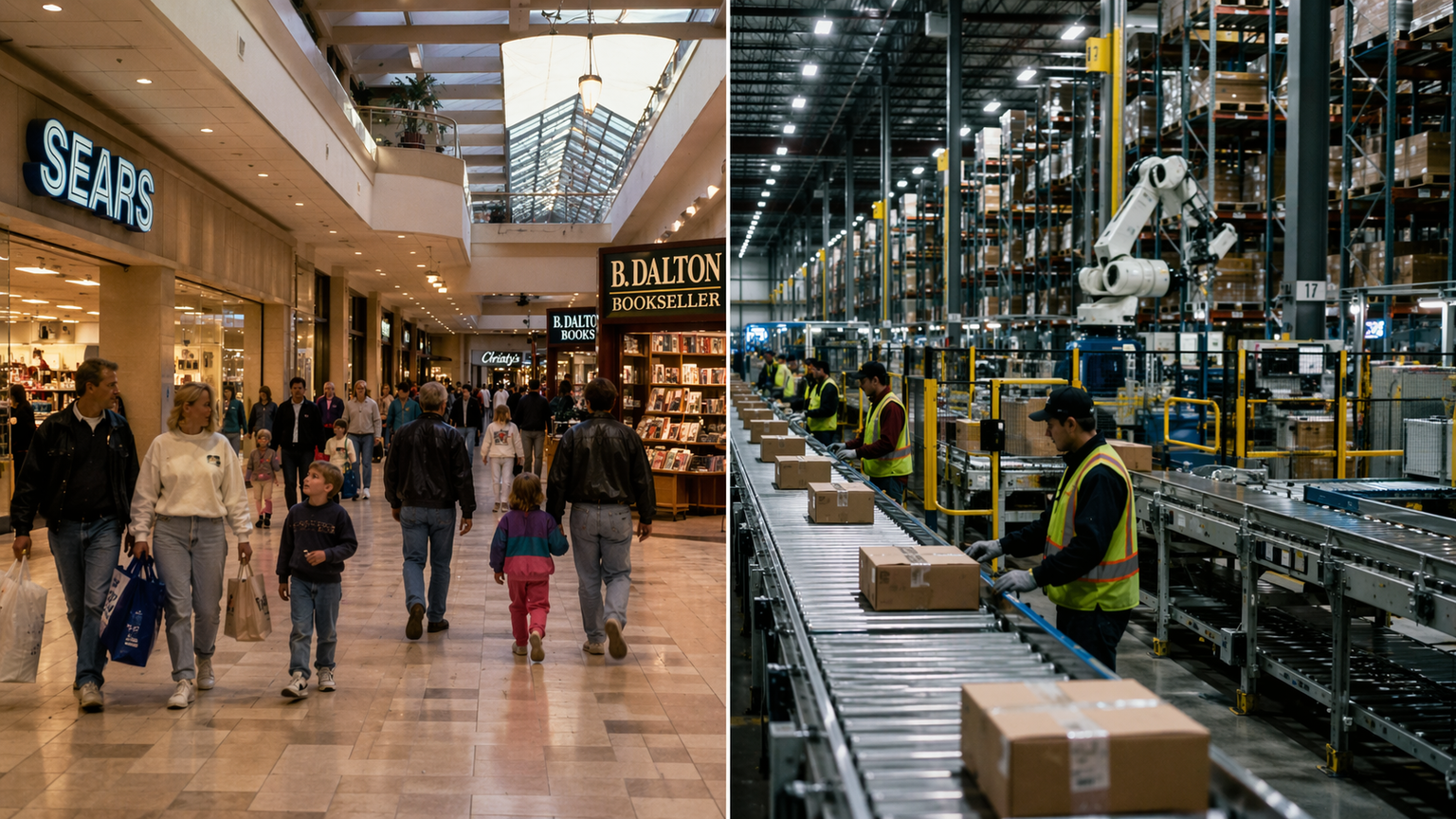
The easy story is that Amazon killed the mall. That story is convenient, widely repeated, and wrong in ways that matter.
The scale of the shift is different from what the headline implies. U.S. e-commerce grew from under one percent of retail in 1999 to roughly 16 percent by 2025. That is a significant change over a long period of time. It is not the sudden displacement that “retail apocalypse” language suggests. The shift happened across two decades, with a COVID-driven acceleration in 2020 that then stabilised rather than continuing upward.
More importantly, Amazon was not the only force. What rewired retail was the combination of cheap search, normalised payments, fulfilment infrastructure, and a generational shift in consumer habits. NBER research on pricing behaviour makes the point with specificity: retailers exposed to Amazon competition roughly doubled their monthly price-adjustment rate between 2008 and 2017, and many moved to uniform national pricing because their customers were now comparing prices in real time from anywhere. That is not one company hurting stores. That is search transparency changing competitive behaviour across entire categories of retail.
AI is beginning to do something structurally similar to expertise pricing. A small business owner who needs a standard contract reviewed can now get a competent first pass from an AI tool without paying for a junior associate’s hourly rate. A founder working through an employment question can get oriented before engaging a lawyer at all. The floor on certain categories of billable time is starting to move, for the same structural reason that search moved retail pricing: clients can now compare. This does not threaten the senior practitioner with genuine judgment and distinctive expertise any more than Amazon threatened Costco. But the opacity that let inefficiency hide, the billing model that bundled high-value judgment with routine document assembly and called it one service, is starting to look like a vulnerability.
The actual store employment numbers are more complicated than the coverage suggests, too. If you include restaurants and service businesses when you look at physical retail (which most press analysis does not), the sector returned to 2006 levels by 2017 in both employment and revenue. What changed was the category mix. Electronics stores, bookstores, commodity apparel at scale, and big-box general merchandise contracted. Restaurants, specialty experiences, fitness studios, and service businesses expanded, often into the same spaces. The mall reorganised more than it died.
Class A malls, well-located with strong demographic draws and differentiated tenants, have been running near 95 percent occupancy. Class B and C malls are the ones in distress. That distribution is not consistent with a story where all physical retail is simply losing to e-commerce. It is more consistent with a story where poorly positioned retail was finally meeting the competition it had been partially insulated from for decades.
The Overbuilding the Headlines Skip

The piece of the retail story that almost no one tells correctly is how over-retailed the United States already was before e-commerce reached mainstream adoption.
At the peak, the U.S. had roughly 23 square feet of retail space per capita, more than double most comparable economies. That baseline was fragile regardless of Amazon. Overcapacity creates survival pressure in any market, and U.S. retail had been running on a model that required an unusually high level of consumer spending per square foot just to stay viable.
The anchor store failures of the 2010s illustrate the point. Sears filed for bankruptcy in 2018. Toys R Us liquidated in 2017. JCPenney was in sustained distress for years before its formal bankruptcy. In each case, the real story was internal. Sears had spent years underinvesting in stores whilst managing difficult debt loads. Toys R Us had been taken private in a leveraged buyout that left it structurally compromised well before Amazon became the dominant force in its categories. These were businesses with capital structure problems and strategic failures that would have been serious in any competitive retail environment.
E-commerce accelerated the pressure. It did not create the underlying weakness.
The professional services equivalent is not hard to find. Consulting, legal, and financial services firms built on high-utilisation models, where leverage depends on junior staff handling research, document drafting, and routine analysis, have been running a model that AI directly challenges. Many of those models were already questionable as efficiency propositions. The billing structure that bundled a senior partner’s judgment with a first-year associate’s document assembly into a single hourly rate worked because clients had no alternative comparison point. That comparison point is emerging. The Toys R Us parallel is pointed: firms that have been through ownership changes, run on borrowed capacity, and under-invested in genuinely distinctive capability are going to find the adjustment harder than firms that stayed lean and built real differentiation. E-commerce did not create the weakness in over-leveraged retailers. It exposed it. AI will do the same to over-leveraged professional service models.
What happened to struggling mall space is also worth naming. Conversion to mixed use is now common: restaurants, fitness centres, medical offices, housing, and last-mile logistics facilities are all showing up in spaces that once held department stores. That is not retail dying. That is real estate reorganising to match what a given location can actually support. Blanket statements about malls as a dead category miss that the space is being repurposed rather than abandoned.
What the Good Operators Did
The retailers that navigated the e-commerce transition most effectively were not the ones that tried to out-Amazon Amazon. They were the ones that identified what their format could do that fulfilment centres genuinely cannot, and built from there.
Costco is the example I come back to. Bulk purchasing, the treasure-hunt merchandising model, high membership renewal rates, and the warehouse experience are all format features that online fulfilment has not fully neutralised. Costco invested in logistics and e-commerce capabilities without trying to become a different company. Its format held because it was actually distinctive, not because e-commerce had not yet arrived.
The retailers that fared worst were the ones that added digital presence as a symbolic gesture. A website that performed worse than the store experience. An app that nobody used. An “omnichannel strategy” that reorganised the org chart without changing what customers encountered.
The AI equivalent of the app nobody used is already visible. Firms mandating AI tools that employees quietly route around. Executives announcing AI strategies that amount to adding a chatbot to the website. Organisations creating AI centres of excellence that produce internal slide decks rather than changed workflows. The tell is always the same: the org chart moves, the customer experience does not. That is not transformation. That is the symbolic gesture with a compute bill attached.
The Costco question applies directly to any knowledge worker or firm thinking about AI: what do you do that AI genuinely cannot replicate, and are you building your value proposition from there? For a lawyer, that might be judgment in genuinely ambiguous situations, accountability to the client, or what happens in a courtroom. For a consultant, it might be the political navigation that no model can learn from a briefing document, or the trust built by having been through the hard part of a change programme alongside a client. Those capabilities are not nothing. But they have to be the actual basis of the value, not a rhetorical shield around work that AI can already do adequately.
The technology does not solve the underlying strategic question. It sharpens the consequences of getting it wrong. Organisations that were using physical retail as a comfortable moat against having to think clearly about their actual customer relationships found out that the moat was less deep than they had assumed.
The AI Parallel
I went through the retail history in this much detail because I think it is the clearest available illustration of something that is getting obscured in most current AI coverage.
Technology-driven market shifts do not happen because a new tool is better than the old one. They happen when a new tool is better, reliable enough, affordable enough, and embedded in enough workflows and habits that the old approach starts feeling like a cost rather than a standard. Amazon reached that position through a multi-decade build across logistics, payments, customer trust, and interface convenience. The capability was real from the early years. The embedded behaviour change took the better part of a generation.
AI adoption is at roughly the stage where e-commerce was in the early 2000s. The capability is clearly real. Bick, Blandin, and Deming found that by late 2024, roughly 40 percent of the U.S. working-age population had tried generative AI, and 23 percent of employed workers had used it for work in the previous week. That is meaningful adoption. It is not yet embedded habit.
What turns a useful tool into a rewired behaviour is not a better demo. It is the removal of enough friction, reliably enough, that using it becomes the path of least resistance. Prime got there on delivery time and selection breadth. AI will get there, in whatever areas it genuinely gets there, through reliability, quality, and workflow integration that makes the old approach feel slower. Right now, trust and workflow integration are the laggards, equivalent to where payment trust was for e-commerce in 2001. The underlying capability existed. The surrounding conditions had not yet aligned.
Current AI products are uneven on all three counts. Some are excellent in specific contexts. Some are expensive and mediocre. Some perform well on bounded tasks and degrade badly at the edges. That is also what early e-commerce looked like from the outside. The question for any business or professional positioning for what comes next is not whether AI matters. It is which of these current use cases will survive long enough to become embedded habit, and which ones are still too narrow, too unreliable, or too expensive to hold the ground they appear to be claiming.
The retail executives who looked at early Amazon and concluded “internet retail does not matter yet” were right about the near term and catastrophically wrong about the direction. The retail executives who looked at early Amazon and immediately declared the physical store dead were wrong about the timeline, the mechanism, and which parts of their business were actually exposed.
There is a version of that same error available to every executive and professional thinking about AI today. Calling everything a bubble is too easy. So is treating every demo as destiny. The useful work sits between those positions: separate speculative excess from durable behaviour change, then ask which habits will remain after the easy money, bad products, and inflated claims burn off. Retail did not become Amazon-shaped because every e-commerce company was sound. It changed because search, payments, logistics, and trust became embedded enough to alter the baseline. AI will only deserve the same comparison where it does the same thing.
I spent years at 5GuysTech learning what it costs to be directionally right but structurally wrong about the timing, mechanism, and market. The technology does not owe you a return on your conviction. It just keeps building the infrastructure underneath you, whether you are paying attention or not.
Further Reading
- Chava, Oettl, Singh, and Zeng, “Creative Destruction? Impact of E-Commerce on the Retail Sector” (NBER Digest, August 2022)
- Alberto Cavallo, “More Amazon Effects: Online Competition and Pricing Behaviors” (NBER, 2018)
- Shane Greenstein and Ryan McDevitt, “The Broadband Bonus: Accounting for Broadband Internet’s Impact on U.S. GDP” (NBER, 2009)
- Anders Bick, Adam Blandin, and David Deming, “The Rapid Adoption of Generative AI” (NBER, 2024; revised 2025)